

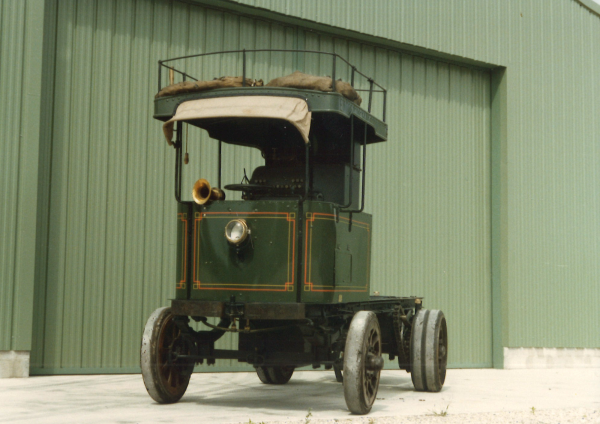
PURREY, « THE KING OF LORRIES »
At Retromobile 2025 from 5th to 9th February, the Berliet Foundation will be showing a very rare piece of exhibit : a 1909 PURREY steam lorry.
In 1886, Valentin Purrey (1861 – 1928), born in Layrac (Lot & Garonne, France), set up his first steam railcar in Barcelona (Spain) to provide a regular service in the city. In 1890, he returned to his native region an built a factory in Bordeaux-Bègles which, a few years later, covered 10 hectares and employed 450 people.
While continuing to build successful self-propelled railcars (also known as railmotors) for numerous urban networks in France and abroad, this selt taught engineer began working on automobiles in 1898. He presented the prototype of a steam-powered lorry with a payload of 5 tonnes, fitted with a 2.7-litre 120 x 120 double-action 2-cylinder engine, an ‘absolutely non-explosive’ generator, a 600-litre water tank and wooden wheels with metal bands. It could reach a speed of 15 km/h and climb gradients of 12%. It used an average of 5.7 of coke and 20 litres of water per km. In 1909, the Raffineries Say, ordered 34 Purrey Lorries to replace its 400-horse livestock and wagons : 16 x 10-tonne units and 18 x 5-tonne units. It was the first fleet of motorised industrial road vehicles in the world !
At the beginning of the 20th century, when there were three competing forms of propulsion – steam, electricity and petrol – steam traction offered a number of advantages : it was simple, robust and reliable, as there were no fragile components that were a source of problems (carburettors, clutches, etc.), braking was effective due to simple reversal of steam, and running costs were minimal due to the low price of coal.
However, it also had its drawbacks : the weight and bulk of the boiler and the coal and water supplies, the time required to pressurise the generator at start-up (30 minutes) and to clean the boiler at the end of the day, and the daily maintenance requirements, particularly the frequent greasing operations.
Financial difficulties arose in 1910 and Purrey was taken over by Exshaw, which the marketed the equipment under the brand name Exshaw-Purrey, the Exshaw, while V. Purrey was forced out in 1913. Steam traction gradually disappeared with the development of the internal combustion engine. The factory ceased prodution in 1929.
Paris – Expo Porte de Versailles, du 5 au 9 février 2025 – Hall 1 – stand R-027