

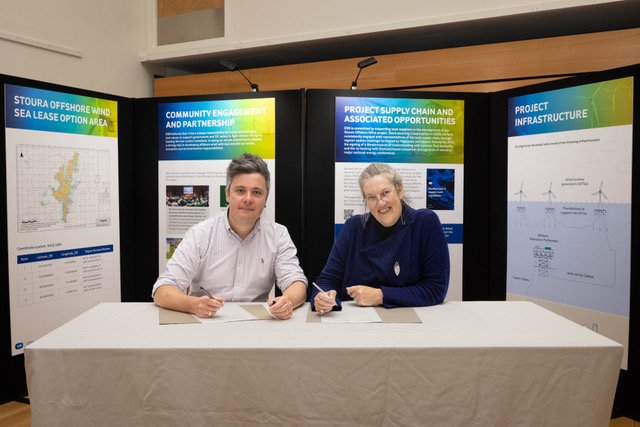
ESB and UHI Shetland has announced details of a recently signed memorandum of understanding (MOU) that will see the two parties establish an arrangement for collaboration and cooperation as part of the Stoura floating offshore wind farm project.
The main areas of focus will be education, data sharing, research and long term environmental monitoring. Both organisations are committed to working together to develop the skills required to deliver on the Scottish Government’s climate action targets.
The MOU was signed at the Stoura public engagement session in the auditorium of the Shetland Museum and Archives on 19th September. Here, members of the ESB team were available to all attendees to answer any questions about the project. ESB will use the input gathered during this public event and other engagements to further refine plans for the project.
Dr. Cian Desmond, Stoura Project Director at ESB, said: “A central focus of this MOU will be seeking to replicate the enormous success of the Shetland Oil Terminal Environmental Advisory Group (SOTEAG) model in the context of a floating wind farm. I hope that through collaborating with the leading experts at UHI Sheltand, we can effectively make Stoura a living laboratory which provides training opportunities and nurtures a local floating wind based knowledge economy.”
Added UHI Shetland Principal and CEO Professor Jane Lewis, “We look forward to working with Stoura on education, teaching and training especially to develop skills to deliver on the Scottish Government’s climate action targets, as well as to support industry demand for the wind renewables sector. Collaborating with Stoura on research and development will be mutually beneficial, and we look forward to working together on student projects.”
ESB and UHI Shetland recently had their first collaboration under the MOU with the delivery of a Joint Nature Conservation Committee (JNCC) recognised Marine Mammal Observer (MMO) Training course in Scalloway. This programme aims to promote potential environmental employment avenues within the marine renewables sector, and contribute positively to species protection efforts as Scotland develops offshore renewable wind energy. The programme has been officially recognised and endorsed by the United Nations Decade of Ocean Science for Sustainable Development (2021-2030). The availability of Marine Mammal Observers in Sheltand will help to ensure that the Stoura wind farm is developed in a manner which will minimise the disruption to marine life whilst also providing local employment opportunities. The training brought together 12 delegates including UHI Shetland staff, marine science graduates, and local community members providing them with key skills and awareness for marine mammal monitoring.
ESB will hold a follow-on public engagement session in 2025 to discuss the onshore aspects of the floating wind farm. Following the exhibition in September, all information will be made available online.