

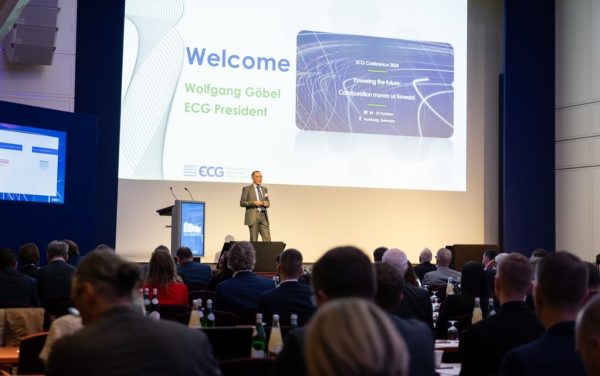
The vehicle logistics industry must find long-term solutions to tackle the challenging market conditions, according to the conclusion of the Association of European Vehicle Logistics conference in Hamburg. “The volumes have stabilized at a low level, which requires the industry to be more efficient through collaboration,” says Wolfgang Göbel, President of ECG.
At the recent ECG Conference in Hamburg, Mark Fulthorpe, Executive Director of S&P Global, provided key insights, predicting that there will be volume stagnation following a volatile period marked by the supply chain crisis, COVID-19 and the war in Ukraine. Since 2020, sales volumes have remained stable, with 2.5 million fewer new cars sold.
S&P Global expects a mere 1% increase for 2025 and anticipates volumes will remain stabilized at a low level until 2030. At the same time, we face geopolitical risks, increased global competition and short cycles. The industry’s challenge is to avoid letting these uncertainties deter us from initiating long-term collaborations. Mark Fulthorpe also emphasized the imbalance between supply and demand.
Mark Fulthorpe, S&P Global: “The short term has been proving pretty painful to the vehicle manufacturers. We’ve been through a period of crisis where demand was often more robust than supply. At the same time, we saw disruption in the manufacturing side, creating an imbalance. There was far greater demand than supply for a couple of years and, in the last 18-24 months, the manufacturing side has been trying to catch up, so a couple of effects have boosted production levels. The first was rebuilding inventory stocks and the second was satisfying the demand that had developed during COVID.”
The forecast requires capacity adjustments and a continuous transformation process for the entire industry, including FVL companies and OEMs. ECG provides a platform for collaboration, standardization, and methodology development, encouraging the industry to actively participate in working groups on the association’s platform to tackle market challenges.
It also provides several initiatives and tools to facilitate efficiency and sustainability, including a bespoke emissions calculation methodology and a new working group on rail to identify opportunities for increased efficiency, securing resilient capacity and decarbonizing.
During the Conference, Frank Schnelle took over as Executive Director of ECG from Mike Sturgeon. Frank Schnelle will continue to lead the challenging work of decarbonization and the next step of reducing emissions.
Wolfgang Göbel, President ECG: “From my observation, our industry is more consequential and stricter in following the transformation than the buying side of the market. The predictions of the volumes exclude growth, so the industry needs to adapt to be more efficient. We must consider avoiding the volatile market’s short cycles by collaborating and keeping pace through the transition. “
Frank Schnelle, Executive Director, ECG: “The association has demonstrated excellent examples of close co-operation across various areas of the industry, but there is still room for growth. ECG provides an excellent platform to collaboratively develop long-term solutions that make our industry more effective and, above all, more resilient.”
*Full report from the event in the next edition of Fleet Transport