

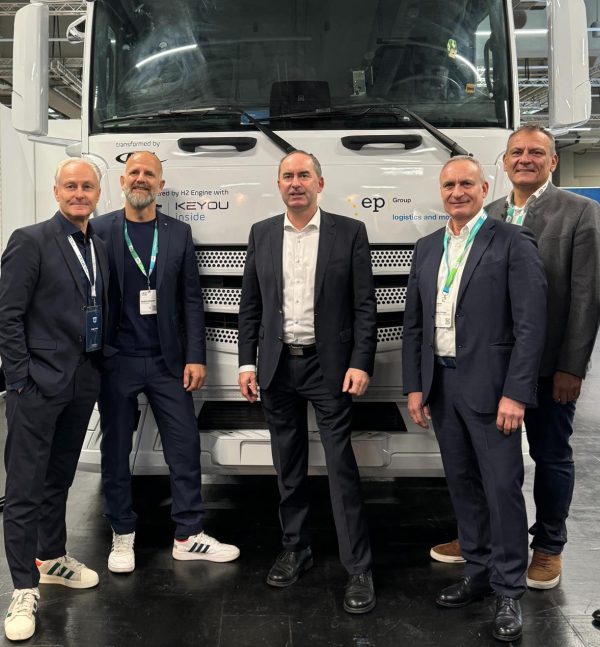
KEYOU, a German technology company specialising in the development and implementation of hydrogen combustion engines for heavy-duty trucks, officially handed over its first 18-tonne truck with a hydrogen combustion engine (H2ICE) to logistics company, EP-Trans, at the recent Hydrogen Dialogue Summit and Expo in Nuremberg.
The truck is based on a Mercedes Benz Actros chassis (4×2) and is equipped with a 7.8-litre Deutz six-cylinder in-line engine which, after conversion to hydrogen operation, generates an output of 210 kW (281 hp) and a maximum torque of 1,000 Nm. An Allison 3000 SeriesTM fully automatic transmission is integrated into the vehicle to offer exceptional reliability and durability.
The vehicle was converted by KEYOU in collaboration with special-purpose vehicle conversion and construction company, Paul Nutzfahrzeuge GmbH of Vilshofen. It is set to start operation from early 2025 with EP-Trans Internationale Speditions-GmbH, an owner-operated logistics and transport company headquartered in Regensburg, Germany, where it will serve an international steel group in Bavaria.
“The handover of the first KEYOU hydrogen truck from our pioneer fleet to EP-Trans is an important step towards emission-free logistics. Our technology not only offers an environmentally friendly alternative to diesel trucks, but also an economical one. By integrating the Allison fully automatic transmission, we achieve optimum performance,” said Jürgen Nadler, Chief Marketing Officer, KEYOU GmbH.
Markus Pumpf, Managing Director of EP-Trans, explained, “From the outset, we were extremely interested in KEYOU’s technology and concept, as it was clear to us that electric trucks were not a viable option for our purposes.”
Georg Ehrlinger, also a Managing Director at EP-Trans, added, “We were looking for and found a solution that would enable us to make emission-free deliveries to our customers without compromising on range or efficiency and without having to deal with long recharging times. The converted H2 engine is based on a mature diesel engine platform, and we expect it to have the same high reliability and durability as a diesel engine.”
The 18-tonne truck from KEYOU is setting a new benchmark for sustainable truck technology. By combining the KEYOU hydrogen engine, the powerful Allison 3000 R transmission and zero-emission technology, the vehicle will contribute to the decarbonisation of the transport sector. It offers logistics companies such as EP-Trans a cost-effective and powerful solution that not only reduces CO2 emissions, but also minimises operating costs and noise emissions.
Allison fully automatic transmissions are fuel agnostic and enable optimal integration with several energy sources, from diesel to natural gas to hydrogen. They deliver durability and powerful performance to support sustainability goals without sacrificing fleet productivity and efficiency. Allison’s power shift technology and torque converter significantly improve startability, drivability and overall productivity, offsetting the lower power and slower engine response often associated with alternative fuels.
“Allison transmissions offer exceptional flexibility and are designed to integrate seamlessly with different fuel types. The 3000 R transmission is a prime example of the adaptability of our technologies. It not only enhances the drivability and acceleration of the hydrogen truck, but also increases the energy efficiency and range of the vehicle. This integration demonstrates how crucial the choice of transmission is for the performance of hydrogen combustion engines,” said Christian Bock, Area Sales Manager, Allison Transmission.
According to KEYOU, with an efficiency of up to 45%, the hydrogen combustion engine outperforms the latest diesel engines while reducing vehicle emissions. In terms of efficiency, the hydrogen truck performs at approximately the same level as a modern LNG truck. When compared to conventional diesel engines, vehicles with H2-ICE engines reduce CO2 emissions by 99.7%. As a result, they are considered zero-emission vehicles in both the US and Europe and are therefore exempt from road tolls.