

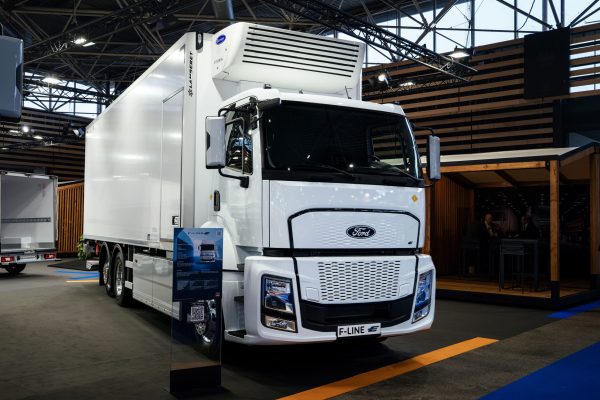
From Ford Otosam Turkey –
At Ford Trucks, we are driving the future of mobility with a clear vision: delivering innovative, eco-friendly, and high-performance solutions for the transportation industry.
As part of this vision, we have taken two significant steps this year. The first was the successful sale and delivery of our first all-electric truck to ATS Transport B.V., an important logistics company in the Netherlands, a solid example of how we are turning our vision into reality.
The second milestone was showcasing the F-LINE E and the New F-MAX at Solutrans 2025, further demonstrating our commitment to innovation and sustainability.
We continue to lead the way toward a greener future. By combining durability, advanced technology, and sustainability, we reaffirm our promise to create reliable transport solutions that reduce environmental impact and support our customers in their transition to electric mobility.
To further demonstrate our progress, we are pleased to share a comprehensive set of detailed documents and images of the F-LINE E, highlighting its features, benefits, and role in shaping the future of transportation.
Global Sustainability Commitment
Ford Trucks’ dedication to sustainable mobility is formalized by the signing of the “Zero Emission Freight Transportation” declaration. This commitment mandates that all new trucks sold by 2040 will be fossil fuel-free, with the overarching corporate goal of achieving carbon neutrality by 2050. The introduction of the E-Truck (F-LINE E) is a direct, significant step toward the 2040 target.
R&D Leadership
R&D efforts are being accelerated to pioneer and develop the future generation of zero-emission electric transportation solutions. Furthermore, participation in the European Union-funded NextETRUCK project provides a platform for collaborative research, which is set to reshape the logistics industry through the deployment of efficient and low-cost next-generation electric trucks.
Comprehensive Charging Infrastructure Support: A seamless transition to electric operation is ensured through robust support services. Consultancy is provided to assist customers with the installation of charging units that are 100% compatible with the vehicles, carried out via designated partners at customer depots. Support is comprehensive, ranging from the planning of the necessary electrical infrastructure to the provision of financial solutions. Solutions are offered to help F-LINE E fleets charge with maximum efficiency, covering everything from compatible charging units to infrastructure setup, fleet management, and digital solutions.
Battery Circularity: For a sustainable world, transformation (recycling) solutions are provided by Ford Trucks for batteries that have reached the end of their economic lifespan, promoting a circular economy approach.
KEY PILLARS OF DIFFERENTIATION
I – High-Efficiency Electric Powertrain
The F-LINE E is engineered for robust performance and operational efficiency across a variety of demanding applications.
Peak Power and Torque: The model features a Dual eMotor, Permanent Magnet Synchronous Motor (PMSM) powertrain. It delivers continuous power of 310 kW (421 PS) and an impressive peak power of 390 kW (530 PS) for 6×2 axle variant. The instantaneous torque ranges from 1370 Nm to 2470 Nm, ensuring strong performance, particularly during hill climbs and heavy-duty operations.
Advanced Energy Recovery: The system boasts a high regenerative braking power of 390 kW. This energy recovery mechanism is designed to improve the operational range by 10-20%.
Durable Design: The vehicle is built for exceptional durability, with its structure and powertrain rigorously tested under extreme conditions, ranging from the freezing cold of Scandinavia to the heat of the Gulf.
II – Smart Battery and Charging Management
Minimizing operational downtime and maximizing battery service life are central to the F-LINE E’s design.
Long Range Capability: The F-LINE E offers a practical operating range of up to 300 km when fully loaded, depending on the configuration and usage (up to 250 km for 4×2 and up to 300 km for 6×2).
Rapid Charging: Utilizing DC CCS2 fast charging, the truck can recharge from 20% to 80% in approximately 50 minutes under optimal conditions. Charging power is supported up to 213 kW for 4×2 models up to 285 kW for 6×2 models.
NMC Technology: The vehicle is fitted with Nickel Manganese Cobalt (NMC) batteries, offering high energy density, a longer lifecycle, and enhanced safety.
Intelligent Battery Management: Features such as an integrated Thermal Management System, Programmable Pre-Conditioning, and the flexibility to select between long-life or fast-charging modes optimize battery health and ensure optimal performance across varying temperatures.
III – Operational Versatility and Driver Comfort
The F-LINE E is designed to lower the Total Cost of Ownership (TCO) while elevating the driver and fleet experience.
Payload Efficiency: The platform supports high technical Gross Vehicle Weights (GVW), with the 4×2 variant rated up to 19 tonnes and the 6×2 up to 27 tonnes. This high payload efficiency is engineered to minimize required trips and lower overall operational costs.
Low-Noise Operation: The electric motor significantly reduces noise and vibration, providing a quiet and comfortable driving experience, making it ideal for urban logistics and night-time deliveries.
Integrated Telematics: The standard ConnecTruck technology provides fleet managers with a single, integrated platform to monitor and manage critical data, including vehicle location, consumption, service status, and charging status, facilitating optimized fleet operations.
Auxiliary Power: The Electromechanical PTO (Power Take-Off) provides zero-emission power for auxiliary systems, such as water tanks or garbage compactors, ensuring full functionality for specialized applications.
Comprehensive Safety (ADAS): A robust Advanced Driver-Assistance Systems (ADAS) package is provided, including Intelligent Adaptive Cruise Control with Stop & Go (IACC), Pre-Collision Assist with Pedestrian Detection, Blind Spot Information System (BLIS), and Moving-off Information System (MOIS).