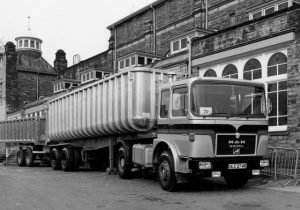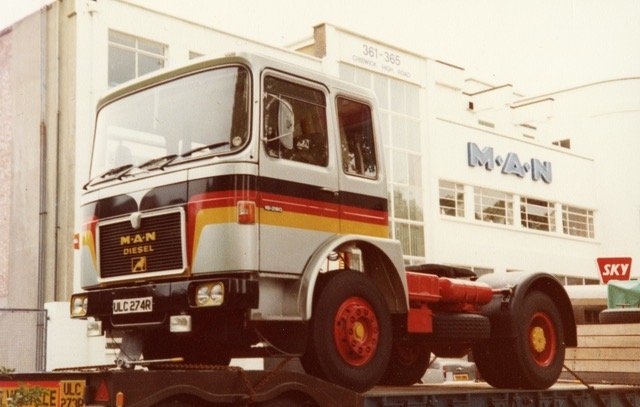
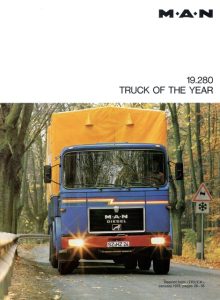
 MAN was still a relatively new name in the British market when the 280 was announced as the Truck of the Year (ITOY) for 1978. The naturally aspirated 16.232 had been offered since 1974, but the design improvements made to the new model really caught the judge’s attention.
For the second award, Pat Kennett recruited some European expertise and opinion with the inclusion of technical experts from The Netherlands, Denmark and two from Germany, with Kennett acting as the foreman of the jury. At this time, these four countries were responsible for 70% of road freight carried in the European Economic Community.
The judging criteria was also further refined so that only new models available on the market in the preceding 18 months were admissible, and these were awarded points based on operating performance, engineering excellence and cost.
So, in January 1978, the MAN 280 was announced as that year’s winner with 29 points, having – perhaps unexpectedly – beaten the new Volvo F10/F12 range by a margin of two points. Whilst the Volvo’s cab was afforded high praise, the truck was regarded as “over-engineered for many users” leaving the MAN to take top spot with, “An unspectacular formula giving great reliability and high operational efficiency.”
Much thought had certainly gone into the MAN design. The new D.2566MTF engine was a turbocharged development of the existing 11.4-litre straight-six with a longer stroke and new crankshaft. The 280hp engine was governed to 2,200rpm and retained MAN’s M-System spherical combustion chamber with new oil-cooled pistons and improved inlet ports and water circulation.
During 1977, about one third of all MAN trucks, and half of MAN tractors, were 280-powered, with the new model being nick-named “The Whisper Truck” on account of its quiet running.
The 13-speed Fuller Roadranger with column-shift was selected as the optimum transmission for the new engine, but a ZF option was available in markets with a high resistance to constant mesh designs. MAN’s hub-reduction rear axle was the standard fitment with either 4.64, 5.22, 5.94 or 6.73 ratios, but the top two were most common for on-road work. The British version of the truck was the 16.280 with an 11-tonne rear axle, whereas a 13-tonne axle was specified on the European 19.280 variant, which was also offered with full air suspension.
Remarkably for a Truck of the Year, the Saviem-designed cab was over a decade old in 1978, but in testimony to its advanced design, it was still an excellent workplace in the late 1970s with a very good interior build quality and MAN’s engineers had re-designed the dash panel for optimum visibility.
No truck is perfect though, and a 1977 CM test, although generally very favourable, found the 16.280 be thirsty on part-throttle running at 40mph and better-suited to hard work on motorways.
Credits: Richard Stanier & ITOY