

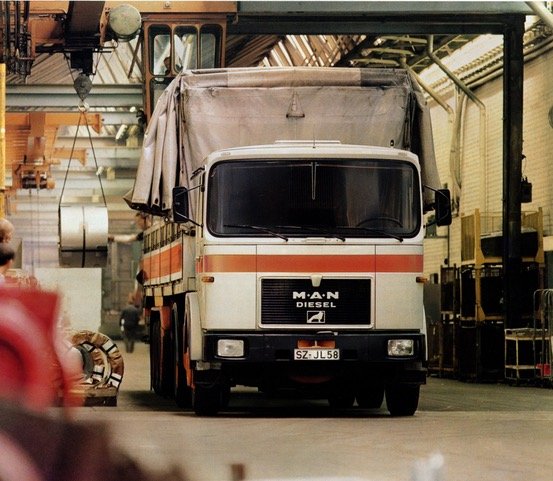
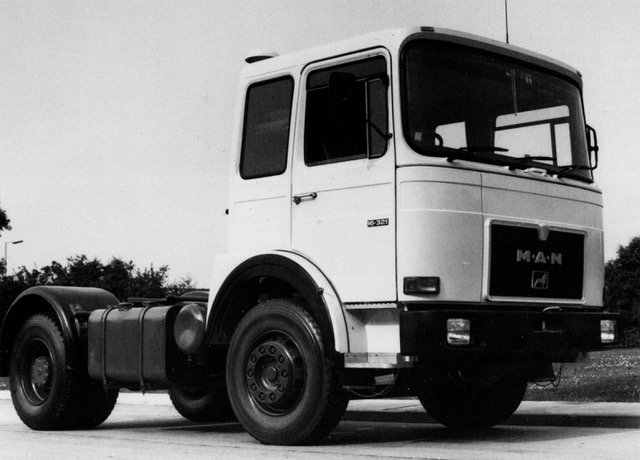
MAN’s second International Truck of the Year (ITOY) award win came within two years of its first, with the victorious 321 model essentially being a development of the earlier 280.
1980’s runners-up were the DAF 2800 DKSE – an economy-tuned variant of the long-serving 2800 which wasn’t available in the UK at that time – and the Fiat (IVECO) Daily, which punched above its weight from the light truck sector.
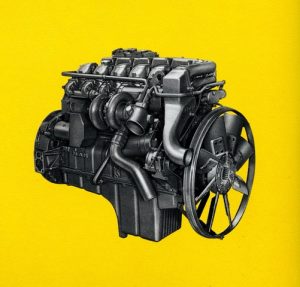
MAN’s trump card was the new 320hp 6-cylinder D2566MK engine which caught the jury’s attention with its tuned induction resonance system and intercooler. Improving turbocharger output and fuelling produced the required increase in power, while an intercooler reduced the air charge temperature to 50°C. The induction resonance system was designed to overcome the then common obstacle of turbo-lag and low torque production at low engine speeds.
Essentially, the MAN system used an impulse charge system to draw a greater volume of air into the cylinder at around 700rpm – 900rpm. The incorporation of a balance chamber provided the advantage of drawing air from a relatively still source, rather than from a fast-flowing stream.
The new technology won plaudits for its ability to generate greater torque at low speeds than any other 11.4-litre engine of the day, with the added bonus of the thorough combustion system resulting in very clean running. This was quite a leap forward from the earlier MAN D2530 engine which had developed 330hp from its 16 litres and 10 cylinders.
In contrast to 1979’s winner – the Volvo F7 – the MAN 321 was an improved model within a range, rather than a new range in itself, and was typically seen in Europe as the 19.321 4×2 tractor, or as a 3-axle truck for drawbar-trailer operation. British operators had to wait until October 1982 to buy the 16.321, following its launch at that year’s Motor Show. By this point the earlier 280 model had also received charge cooling and resonant induction to become the 16.281, and the engine technology eventually spanned the 170 to 360hp output range marketed under the “MAN System Six” name.
The 321 featured a slightly taller cab than its predecessor with improved bunks, more extensive carpeting, a pneumatically suspended driver’s seat, electronically-controlled exhaust brake and a simplified cab tilting mechanism. Externally, a new three-piece bumper coated in black plastic identified the new model.
Constant mesh transmission was retained in the form of the 13-speed Fuller RTO 11613 Roadranger, but now with a floor-mounted gear lever, mated to the MAN H7 hub-reduction axle rated at 11 tonnes in Britain and 13 on the Continent.
MAN was the first manufacturer to fit the new generation of lower-profile Michelin XZ Pilote tyres, which had the approximate height of an 11.00 tyre but with a weight-carrying capacity of a 12.00. These were fitted as standard on all new 321s.
The 321 bowed out in September 1985, with the introduction of the new 12-litre D2866 powered 331 which dispensed with the tuned induction resonance principle in favour of more conventional induction and a modified fuel injection system.
Credits: Richard Stanier & ITOY
CAPTIONS
The MAN 19.321 took 1980’s award by a clear margin
At the heart of the 321 was the D2566MK engine
The 16.321 arrived in Britain in October 1982