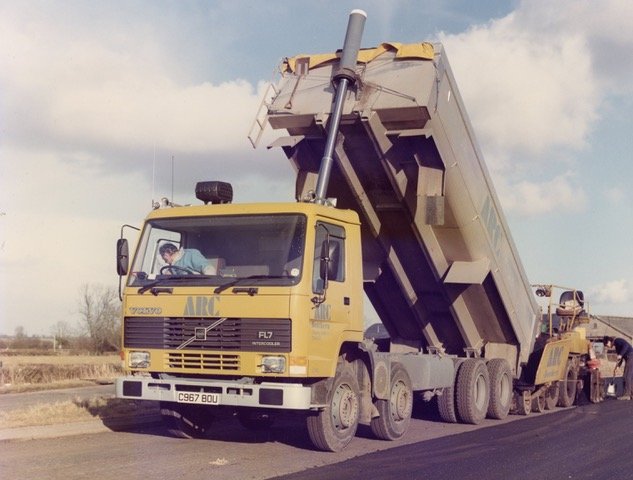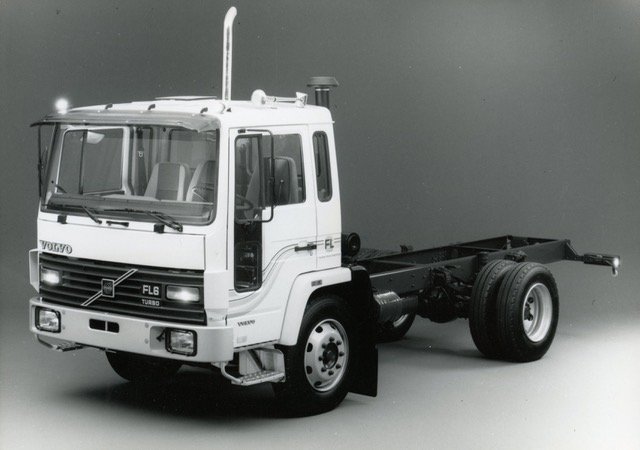
Volvo achieved an unprecedented third Truck of the Year (ToTY) win in 1986 with the FL family which was introduced to replace 1979’s winning F7 range.
Despite its huge success, the F7 was replaced within just seven years as transport technology moved on a pace and the limitations of a 7-litre engine for heavy work became unsustainable.
The 13 judges awarded 121 of the 156 available points to Swedish manufacturers for 1986, with Volvo eclipsing the Scania 92 by just five votes, and the DAF 3600 ATi taking third position on 13 points.
Volvo’s application of technology to the specific distribution, construction and medium-haul sectors, and in particular the focus on reducing long-term operating costs, found favour with the judges. The company’s engineers paid special attention to flattening out the increase in variable costs traditionally associated with higher-mileage, and focused on the four principal areas of basic design concept, engineering development, build quality and field support.
The FL family was somewhat unusual, being made up of two distinct forward-control, low-mounted, designs which spanned the 11- to 38-tonne sector. Whilst the FL7 and FL10 gained the most attention, covering the 16.26- to 38-tonne weight range with intercooled 7- and 10-litre engines, the Belgian-built FL6 slotted into the 11- to 16.5-tonne sector, with tractor units taking the train-weight up to 28 tonnes.
The new cab designs featured improved access and visibility and – controversially – a fixed seat as standard, Volvo’s engineers relying on advanced cab-mounting technology and long taper-leafed, shackled springs to provide an improved ride. Greater front axle weight capacities, tighter turning circles, new brakes jointly-developed with Girling and new wiring systems with a simplified loom and better weather protection were all incorporated.
In addition to the two new cab designs were brand new engines in the 6- and 7-litre classes and the adoption of the F10’s TD101F 299hp engine for the top-power models.
The new engines were entirely redesigned and wholly different from their predecessors, although they enjoyed a degree of commonality with each other in terms of cooling, lubrication and ancillaries. For the FL6, the 5.5-litre TD61G was rated at 152hp for 11-tonne work, with the TD61GS rated at 180hp, and the intercooled TD61F at 207hp. There were automatic and manual transmissions offered with ZF 6-speed or Volvo 8-speed range-change gearboxes.
The FL7 was powered by the TD71 6.7-litre charge-cooled engine, rated at 230hp in TD71F form, or 245hp in TD71FS form with transmission generally being provided by Volvo 8-speed, or 16-speed splitter gearboxes. The new engines incorporated design features from the 1983 10-litre design such as a stiffer block, a gear-driven coolant pump and improved oil-flow to enhance durability.
The FL went on to gain a 12-litre engine in January 1995, before the heavier models were replaced with the FM range in 1998, whereas the distribution sector is still served by an FL model in 2026.