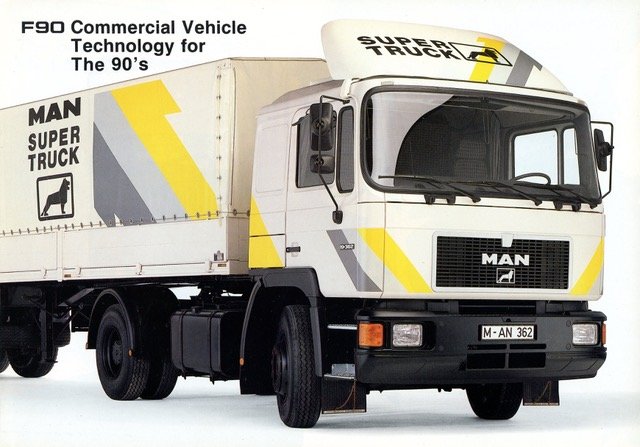
1987 saw MAN hot on the heels of Volvo to secure a third win with the F90.
MAN had last been awarded the Truck of the Year (ITOY) in 1980 with the 19.321, and the intervening years had proven quite rough a ride for the Bavarian manufacturer. Adversely affected by the downturn in the European heavy truck market in the early 1980s, MAN had walked away from a potential deal with General Motors and had sold its interest in the MTU engine business to Daimler Benz in order to offset losses. The F90 was introduced in the Summer of 1986, with MAN having shed 6,000 jobs across its factories.
Compared with other recent winners, the F90 was a relatively cautious launch, with drive axles and engines being modified versions of existing components matched to a brand-new chassis and conservatively-styled cab, introduced initially with just two models – the 19.332 and 19.362 – both in 4×2 configuration.
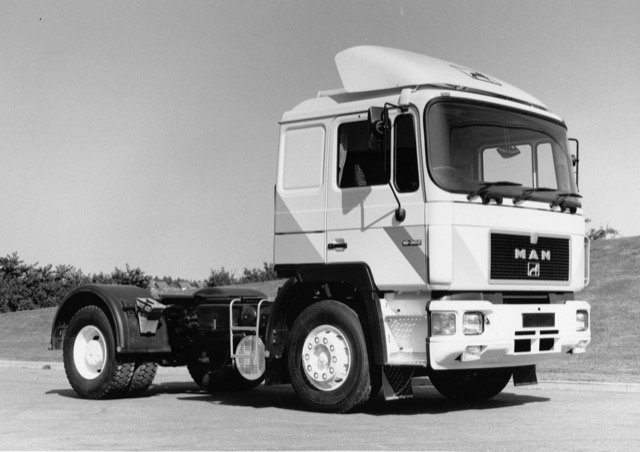
The 13-nation judges were won over by the “brilliantly-engineered” MAN which achieved a clear margin over the Mercedes-Benz Powerliner, and third-placed contender – the “Middle Class” Steyr. The Mercedes lost out due to questions over the necessity of a 450hp engine, and the no-options electronic gearbox, whereas the Steyr’s availability in only selected European markets limited its appeal.
The MAN F90 was introduced with the latest version of the D2866 12-litre engine, which had been improved 18 months beforehand, and now featured increased turbo output at low revs and redesigned piston crowns. With either 332hp or 362hp ratings, the 6-cylinder engine was offered in either vertical or horizontal forms.
The chassis was of an entirely new modular design and developed with the aid of computers to achieve maximum strength at low weight and the component groups and air suspension could be incorporated into any production frame without the need for modification. The truck was also an early design to use a smaller propshaft flange with serrated faces and four bolts, and steering was from the new ZF Servocom design.
A new front axle of 7.5-tonne capacity was introduced, but initially the old 13-tonne hub-reduction drive-axle was retained with bigger brakes before the introduction of a single-reduction design, jointly developed with Eaton.
Transmissions originally comprised the 16-speed ZF Ecosplit or the 13-speed Fuller Roadranger, with Eaton’s Twin Spitter and semi-automatic SAMT joining in due course.
Most attention was paid to the cab, which was a robust and very-well finished and appointed 2.44m wide sleeper with electric windows as standard. Narrower and day versions of the cab were introduced across the MAN range over the following three years.
Whilst some commentators questioned the new cab’s lack of radical styling, many preferred to see a natural evolution from its predecessor and MAN claimed the similarity in styles helped fleets retain a unified identity as newer trucks were introduced.
The cab design was retained with introduction of the F2000 in 1994, eventually being replaced by the TGA models from 2000.
Photos Credit Richard Stanier & ITOY