


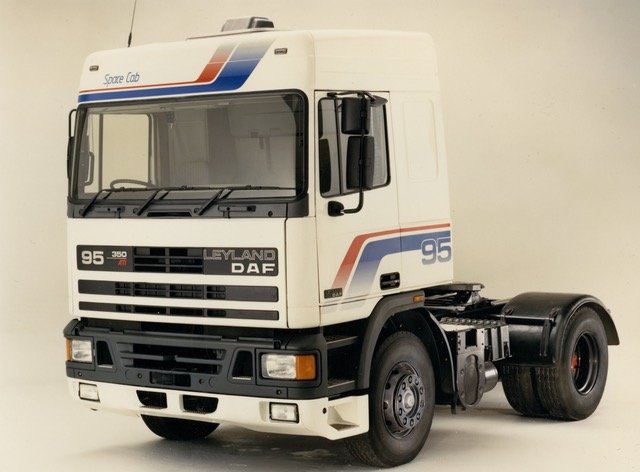
DAF’s first Truck of the Year (IToY) success came in fine style with the 95 Series in 1988.
The ageing F241 cab had hindered DAF in preceding years, despite some important engine improvements, but the 95 impressed judges with its versatility, modernity and technological developments, giving it a 22-point win over Iveco’s Turbostar 360 and the Pegaso Troner.
Of course, the Pegaso shared the Cabtec cab with the new DAF, but the limited availability of the Spanish entry across Europe restricted its appeal to a nonetheless respectable third place.
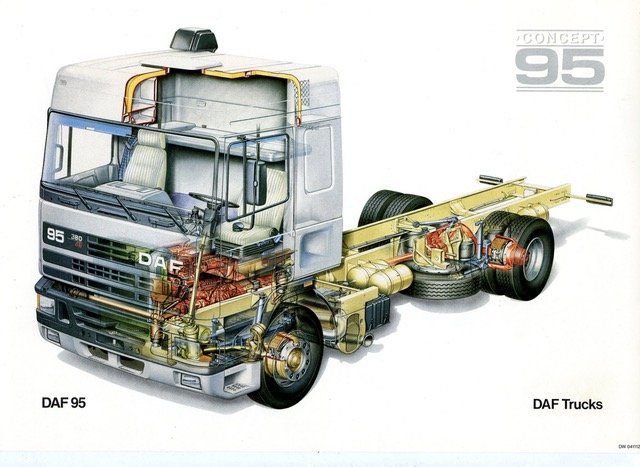
The 95 Series project was conceived as early as late 1979, and when launched in August 1987, DAF could boast a brand-new cab, chassis, rear axle and electronic system matched to a reworked and proven 11.6-litre engine.
Designated “WS”, the new engines retained the existing ATi combustion technology, but incorporated crossflow cylinder heads and the Bosch in-line pump gained its own gear in a new timing case, instead of being driven from the rear of the compressor. These improvements, amongst other measures, were aimed at engine functionality and serviceability. At the launch, the engines were rated at 310hp, 350hp or 380hp.
Transmission duties were handled by the ZF Ecosplit 16-speed ‘box in direct-drive or overdrive forms, but DAF replaced the usual double-H shift pattern with a single H and collar-activated range-change operation. DAF’s long-serving hub-reduction axle was retired for general haulage in favour of a new single-reduction design, designated 1346.
Initially, the 95 was a 4×2 or 6×2 rigid or tractor unit, with a brand new high-tensile steel chassis developed for rigidity, stability and weight saving. “Harmonic damping” was employed whereby the engine mass was used to offset vibrations through the front axle via long parabolic front springs.
In product planning, DAF’s engineers had sought to enhance their brand image of dependable workhorses into a more prestigious bracket and also anticipated the expansion of international pan-European haulage under what became the Maastricht Treaty five years later. To this end, a host of electronic systems were introduced into the vehicle.
The 95 featured an Intelligent Warning System with yellow or red notifications, a Central Timing Unit for general functions like wiper speeds and the E-GAS electronic throttle control with optional features including ABS, Integrated Temperature Control and Electronically Controlled Air Suspension.
The new cab was the result of extensive driver research and pooled with insight collected from the co-designers at Pegaso. Introduced with day, sleeper, space or short top-sleeper variants the design featured three levels of suspension – coil spring and damper for fleet vehicles, electronically-controlled air suspension for the top of the market and rubber for the construction market.
Despite its worthy win, it wasn’t all plain sailing for the 95 and in 1990 the F241-cabbed 3200 was introduced for more conservative and cautious operators whilst the 95’s engine range was re-vamped with 330hp, 365hp and 400hp ratings.
Credits: Richard Stanier + IToY
Captions
DAF’s first Truck of the Year – the 95 Series
The 95 was marketed as a Leyland DAF in the UK – the first model to carry the name
95s matched revised engines to new chassis and cabs