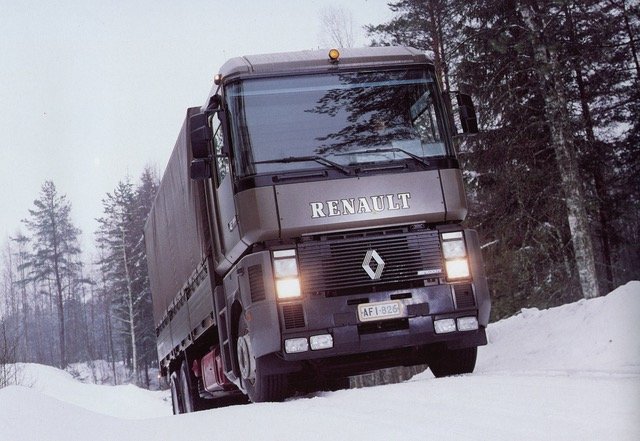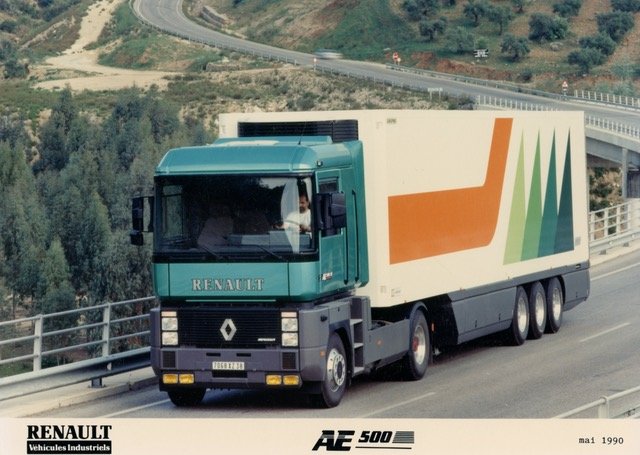
Eight years after Renault’s triumph with the steady G 260, the French manufacturer was back to claim the top honours for a second time with the ground-breaking AE in 1991.
If ever there was a truck guaranteed to catch the attention of the 13 European ‘Truck of the Year’ judges, it was the Renault AE. The genesis of the truck can be traced back to the Virages VE 10 concept truck which was unveiled in November 1985, and as early as August 1987 the press was spotting prototypes out on the road.
At the AE’s launch in May 1990, there was essentially two principal models – the AE 380 and AE 500, but these were configured into a useful range of 4×2, 6×2 and 6×4 tractors and rigids for drawbar operation. The 380 featured Renault’s 12-litre, straight-six, intercooled engine with a rating of 374hp, whilst its more powerful stablemate took the 16.4-litre, 503hp V8 from Mack, Renault’s US subsidiary.
Behind the engine lay a familiar driveline from the well-established R-series, comprising of the 18-speed B18 gearbox and P1345 hub-reduction axle on single-drive models, with the R-series’ disc brakes employed on the front axle.
Now universally referred to as the Magnum, that name was originally reserved for the higher of two cab trim-levels, the other being the standard De Luxe whilst the truck itself was referred to as the Maxicode. However, by early 1992 Renault had adopted the Magnum name across the board for general promotional purposes.
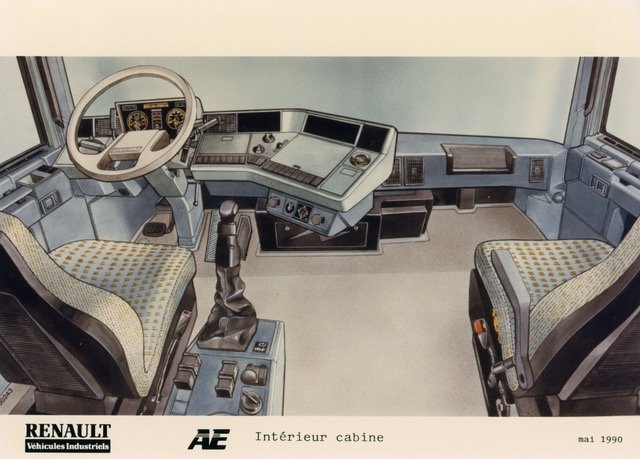
The cab was naturally the focus of attention with the design arising from the Renault engineers’ intention to produce “something really different, focussed on the idea of living in the truck”. A flat floor was integral to that philosophy and the 1.87m of headroom was sufficient to allow most drivers to walk around the cab with ease.
Mounted on active, four-point air suspension which cleared the engine, the steel cab frame made extensive use of plastic mouldings for exterior panels, providing protection from corrosion and reducing the weight penalty of the large cab. The AE was a remarkably tall truck in its day – standing at 3.77m unladen, about 30cm higher than a Volvo Globetrotter.
Once inside the cab, drivers were treated to 8.9cu.m. of space, with two full length aircraft-style lockers, shelving above the windscreen with provision for fitting a TV and two built-in wardrobes with built-in shoe lockers. Fans of both budget hotels and Renault cars may have found themselves at home in the truck, as the designers incorporated some car influences for the dash.
Actually, getting into the cab was also novel with the set-forward front axle necessitating the use of three rear-positioned steps and two long grab-handles to reach the appropriate height before a shuffle over the wheel-arch to the seat. The door handle concealed under edge of the door was another unique design feature cementing the judge’s opinion that “there has never been a truck quite like it”.
Credits: Richard Stanier & IToY