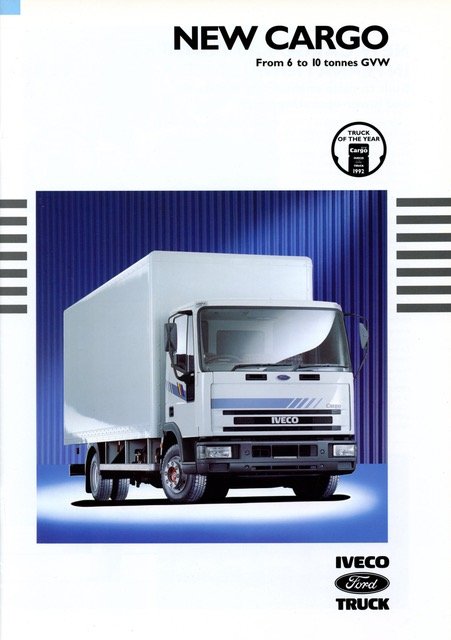
Iveco was the last of Europe’s major manufacturers to win an International Truck of the Year (IToY) title, but did so with fine style and a £2.5bn investment in 1992.
Each of the 13 European judges had 12 votes to cast, with a maximum of seven being allocated to one vehicle, and the new Ivecos scored with all the judges to secure a convincing win on 80 points. Scania’s Turbo-Compound 400 was pushed to second place, and the Low Emission version of the Mercedes SK took the third spot.
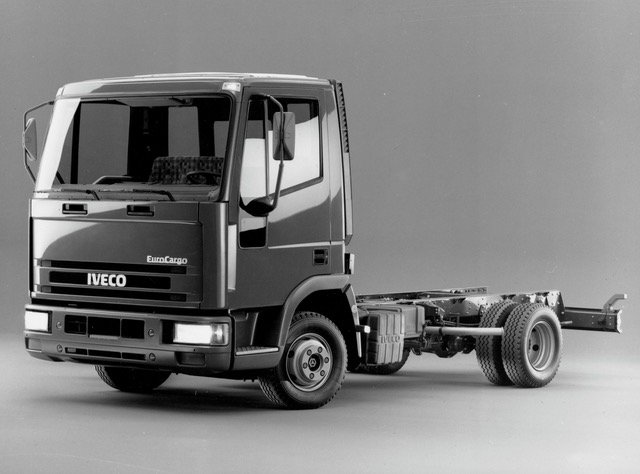
Hailed as the first “all-new” Iveco since the company’s founding in 1975, the EuroCargo’s design brief originated in 1985 as an attempt to streamline the sprawling range of legacy models which included Club-of-Four cab Magirus trucks, Ford’s original Cargo and older designs from OM and Unic.
The EuroCargo was a very ambitious model range – arguably two model ranges, with the 6- to 10-tonne models sharing more engineering features than the heavier versions, which completed the programme up to 15 tonnes in rigid, or 24 tonnes in articulated, form. The 540 standard variants on offer were so extensive they effectively made “special builds” a redundant measure.
The judges always loved a comprehensive and adaptable range of light trucks, and with Euro-1 technology, “exceptional standards of handling and stability” and reduced scheduled maintenance times, Iveco were on to a winner.
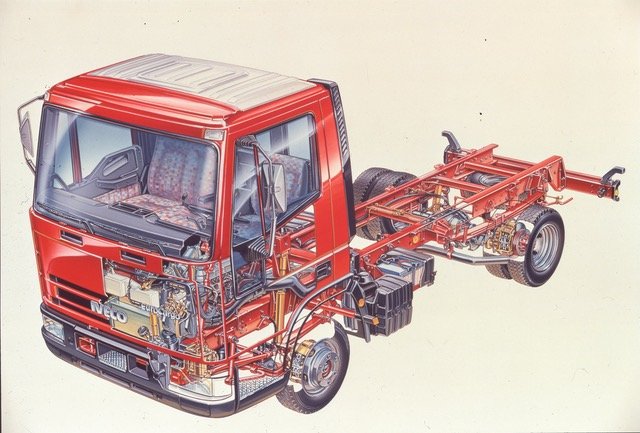
EuroCargo’s power was derived from the existing 8000 series engines, but these had been extensively re-engineered with new piston designs and injectors to improve combustion and reduce smoke. All of the engines were turbocharged and the 4-cylinder versions of 3.9 litres were rated at 116hp or 135hp. Six-cylinder designs of 5.9 litres covered the 143hp, 177hp, 207hp and 227hp ratings, with intercooling employed on the two highest-powered options. A single 7.7-litre engine of 266hp was offered for the heaviest models.
A new range of gearboxes was jointly developed with Eaton, and these were known as the 2800 Series by Iveco. They consisted of 5-, 6- or 9-speed units, with a splitter version of the 6-speed also offered. The gears were of a generous width to reduce noise and prolong durability.
Up to 10 tonnes, EuroCargos used Iveco’s own drive axles, with a choice of up to six ratios on some models, and disc brakes from Lucas were employed all-round. The heavier variants used Rockwell axles with wedge actuator brakes. Suspension options spanned parabolic or multi-leaf springs, parabolic (front) and air (rear) combinations or air suspension all round. Torsion anti-roll bars and telescopic dampers were common to all applications.
The brand-new cab, designed in a joint-venture with Ital Design, was of modular construction and pressed at the Brescia factory which was said to have Europe’s most sophisticated press complex. Much of the assembly work was robotic, and the clean lines of the cab were adapted for Iveco’s heavy range in the years following.
Words & Pics supplied by Richard Stanier
Credit: IToY