

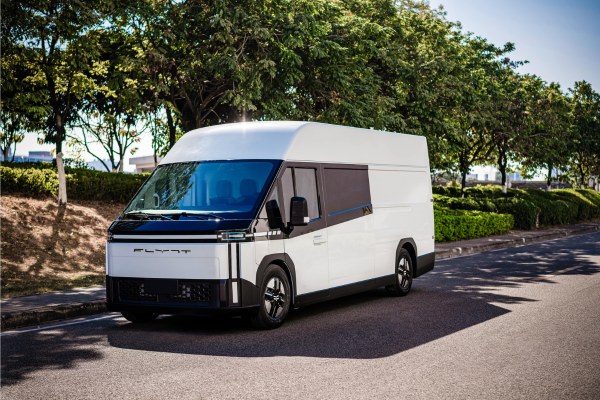
FLYNT has unveiled its first fully electric light commercial vehicle — a purpose-built solution engineered to meet the needs of modern European fleets. But this marks more than the release of a vehicle — it represents the rollout of anentirely new, customer-driven business model built for the electric age.
In the case of FLYNT’s first product, an electric light commercial vehicle, the company is partnering with MiracoMotor – a dedicated eLCV spin-off backed by GAC Group, one of China’s leading EV manufacturers.
“We’re not a carmaker in the traditional sense,” says Dr. Daniel Kirchert, Founder of FLYNT. “We’ve built a smarter, more flexible model – one that puts customer needs first, and uses the best global technology to deliver world-class electric vans faster and more cost-effectively than legacy players ever could.”
The decision to partner with China’s leading EV ecosystem was both strategic and essential. China is more than a global manufacturing hub – over the past years, it has established a leading position in EV technology, driven by::
- Unmatched development speed and R&D scale
- Cost leadership in EV platforms, batteries, and drivetrains
- Advanced digital architecture and software-defined vehicles
- Outstanding product quality, validated at scale
“By integrating this advanced EV technology into a vehicle specifically designed for European fleets, we’re able to achieve a level of efficiency, reliability, and performance that directly translates into lower total cost of ownership,” says Rogan Liu, Founder of FLYNT.“It’s a product built not just for today’s expectations — but for tomorrow’s operations.”
By combining the advanced EV technologies of its Chinese partners with FLYNT’s deep understanding of European fleet needs, regulations, and service infrastructure, the result is a scalable, high-performance eLCV designed to future-proof transport operations — from last-mile logistics to mobile trades.
This new model empowers FLYNT to deliver faster innovation, greater cost-efficiency,and a seamless customer experience, while remaining agile in a rapidly evolving mobility market.
“Our focus is clear: we define the product, design the experience, and own the entire customer journey,” says Moritz Klinkisch, Co-Founder of FLYNT. “We partner with the most innovative players in the industry for development and production — allowing us to stay fast, focused, and relentlessly customer-driven.”
The result is FLYNT’s first electric light commercial vehicle. Designed in Europe, built on a purpose-developed electric platform, and powered by world-class EV technology from China, this vehicle marks a turning point in how commercial fleets transition to zero emissions.
“This isn’t a retrofit. It’s not a compromise,” says Dr. Kirchert. “It’s what happens when you throw out legacy thinking and design something entirely new, around what customers actually need – and then bring it to life through the smartest global partnership you can build.”
FLYNT’s debut eLCV is purpose-built for Europe’s urban, regional, and last-mile operations -combining outstanding efficiency, impressive payload, and a digital-first driver experience, all wrapped in a rugged, versatile design.
· Core Highlights:
- Range:Up to 500 km WLTP (100kWh NCM battery)
- Efficiency:20kWh/100km (WLTP, 5t)
· Charging:
- 22kWAC
- 220kWDC fast charging (30–80% in 20 min)
- Vehicle-to-Gridand Vehicle-to-Load functionality
· Volume & Payload:
- 7to 16.5 m³ cargo space
- Upto 1,630 kg payload
- Platform:Fully electric, native EV architecture — FWD, RWD, AWD options
· Driver Experience:
- 8″main display, 8.8″ cluster
- WirelessApple CarPlay & Android Auto
- Smartstorage, ergonomic access, mobile-office functionality
· Safety:
- ADASwith Level 2 autonomy standard
- L4-readysystem architecture
- 800V System Architecture and comprehensive cybersecurity framework
· Total Cost of Ownership
- Significantly lower than diesel vehicles — driven by high energy efficiency,lowmaintenance requirements, minimal downtime, and smart energy management features