

If truck manufacturers want to reduce their CO2 equivalent footprint (CO2e), wheels must be included in the overall assessment. This applies above all to truck steel wheels: at its European central engineering center in Königswinter near Bonn, Maxion Wheels has been working for decades to further optimize the delicate balance between weight and strength.
“When you look at a truck wheel, it seems simple,” says Karl Rode, Director of Engineering at Maxion Wheels. “But every kilo we remove without compromising safety requires thousands of hours of design, simulation, and testing.”
This pursuit has paid off: since the late 1990s, Maxion has reduced the weight of its standard 22.5 x 9.00 steel truck wheel from 41 kilograms to just 32 kilograms. The company’s latest development even breaks the 30-kilogram barrier for the first time, setting new standards in lightweight steel construction. It is obvious that the weight reduction – while maintaining safety, quality, and performance – has a positive effect on payload and fuel efficiency.
An underestimated climate factor: the advantage of green steel
“Through advanced simulation and materials expertise, our Lightweighting Process offers lighter, stronger wheels that enhance performance and sustainability for our customers,” emphasizes Zeferino Neto, Chief Technical Officer, Maxion Wheels. Conversely, a lighter wheel design also requires less raw material, which further reduces the carbon footprint.
This is because in the manufacturing process, the CO2e footprint of a wheel mainly results from raw materials and energy, with raw materials accounting for around 75 to 85 percent.
In a cradle-to-gate assessment, conventional steel wheels currently generate 133.45 kg of CO2 per wheel during production. By using “green steel,” Maxion can reduce this figure to 44.9 kg of CO2 – a reduction of 66 percent.
The use of environmentally friendly steel in wheel production thus significantly accelerates the path to sustainability. “Sooner or later, green steel will become the norm,” affirms Stan Mommers, Vice President of Sales EMEA at Maxion Wheels. “We’re ready for that transition.” In addition, Maxion Wheels has set itself the goal of using 90 percent renewable energy by 2030.
Transparent calculation of wheel sustainability
Another lever for monitoring and presenting CO2 reduction potential is the use of life cycle assessments (LCA). As part of the cradle-to-gate LCA, Maxion Wheels and its industry partners have developed a methodology for sustainability indicators that meets the industry’s need for an assessment approach to calculate and report the CO2e footprint.
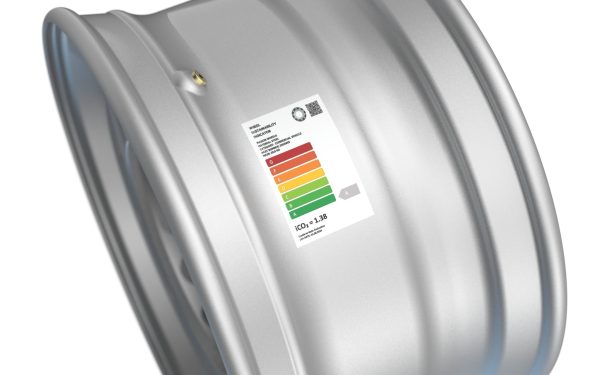
To provide as realistic an overall picture as possible, this also takes into account the weight and load capacity of the wheel, expressed as a lightweight construction indicator (maximum wheel load divided by the net mass of the wheel). When combined, i.e., including CO2e manufacturing values, a meaningful “Wheel Sustainability Indicator” can be defined.
Attached to the wheel, such an indicator would, similar to the EU energy label, give vehicle manufacturers and consumers a clear indication of how “environmentally friendly” the wheel is. Giorgio Mariani, Chief Commercial Officer, Maxion Wheels, sums it up: “Being able to assess the CO2 of each wheel ensures a transparent enterprise approach to sustainability.”
Technology for the electric future
Meanwhile, development continues apace, not least due to alternative drive systems. In particular, the increasing adaptation of battery-electric trucks is influencing wheel design requirements. Heavier vehicles mean higher loads (a battery-electric tractor unit easily weighs three to four tons more than a comparable diesel model), while aerodynamic efficiency becomes crucial for range.
Maxion is also addressing these challenges:
- Next-generation steel wheels offer a weight-neutral load increase of 250 kg and a load capacity of 4,250 kg. They ensure durability without adding mass.
- The lower cooling requirements of brakes in electric vehicles allow for smaller ventilation openings, enabling sleeker, more aerodynamic designs.
- Advanced simulation tools help engineers optimize every curve and contour for strength and efficiency.
“Our goal is simple,” says Rode. “Keep the wheels as light as possible while making them strong enough for the demands of electric trucks.”
A century of strength and innovation
Maxion Wheels was founded over 100 years ago and has grown to become one of the world’s largest wheel manufacturers. The company produces more than ten million truck steel wheels annually for almost all major truck and trailer manufacturers and will soon begin production of forged aluminum truck wheels at a dedicated new plant in Turkey.
Because the extraction and processing of raw materials contribute so significantly to the company’s carbon footprint, Maxion Wheels joined ResponsibleSteel (RS) and the Aluminum Stewardship Initiative (ASI) in 2022 to help shape sustainable standards and certifications for the steel and aluminum industries. This standardization work creates added value not only for Maxion as a wheel manufacturer, but also for OEMs and suppliers.