

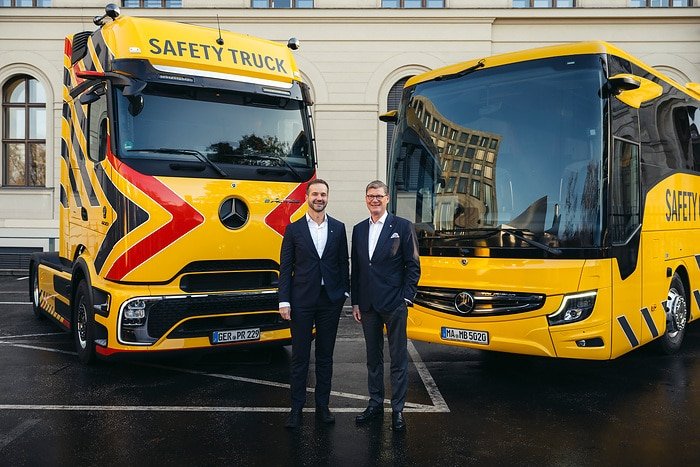
The Daimler Truck divisions Mercedes‑Benz Trucks and Daimler Buses are supporting the new nationwide initiative “Deutschland blickt’s” (“Germany gets it”) by Blicki e.V. The association has a network of experts specializing in child‑friendly mobility education and has already trained over 90,000 children across Germany. The initiative, which will launch in 2026, focuses on new challenges in road safety arising from the increasing electrification of road traffic — such as altered driving behavior and new soundscapes.
This was announced today at the Federal Ministry of Transport in Berlin at a joint press event by VDA President and Blicki ambassador Hildegard Müller, Achim Puchert, CEO Mercedes‑Benz Trucks and member of the Board of Management of Daimler Truck, as well as Till Oberwörder, CEO Daimler Buses, and Dirk Hendler, Managing Director of Blicki e.V.
Trucks and buses, as large and heavy vehicles, play a particularly important role in road safety, as accidents involving them often have more serious consequences. Mercedes‑Benz Trucks and Daimler Buses pursue the vision of accident‑free driving and rely on active and passive safety systems as well as training programs for drivers. The manufacturers are consistently driving the transformation toward electrified trucks and buses and, as two of the industry’s pioneers, already offer numerous electric production models.
For these vehicles, the two Daimler Truck divisions provide additional safety systems.
As market share leaders in Germany, they plan to support the initative by providing vehicles as well as sales and service locations for events focused on training.
The multi-year initiative aims to raise awareness for more consideration, caution, and foresight in road traffic. Its goal is to promote a new sense of togetherness on the road — something that is becoming increasingly important in the age of e‑mobility. Another key motivation is the growing aggressiveness in road traffic: according to a recent ADAC survey, two‑thirds of drivers perceive increasing aggression on the roads (1). The initiative seeks to send a clear message in favor of greater mutual attentiveness. “Deutschland blickt’s” will launch in Saxony, Bavaria, Hesse, Berlin, and Hamburg, and will involve additional supporters from business, sports, and society. It focuses on education, especially targeting primary and elementary school children and their families.
Current figures from the Federal Statistical Office highlight the relevance of the initiative: last year, a child was injured or killed in road traffic every 19 minutes. This corresponds to around 27,260 children under the age of 15 (2). On average, eight people died every day as a result of road traffic accidents — a total of 2,770 individuals (3). According to the latest figures published by the EU in February 2025, based on the CARE database, in 2023 around 90 percent of fatalities in accidents involving commercial vehicles over 3.5 tons were people who were not occupants of those vehicles. Car occupants accounted for about 50 percent of the fatalities, followed by pedestrians at around 15 percent, and cyclists at approximately 6 percent. In bus accidents, around 20 percent of the fatalities were bus occupants — passengers and drivers — while approximately 34 percent were car occupants, around 29 percent pedestrians, and about 9 percent cyclists (4).
Achim Puchert: “Trucks keep the economy and our daily lives running and are therefore an integral part of road traffic. As the leading manufacturer in terms of market share in Germany, we are aware of our special responsibility and aim to ensure a high level of safety for drivers as well as for other road users with our vehicles. To achieve this, we offer state‑of‑the‑art assistance systems and continuously develop them further. There will always be technical limitations, and responsibility will continue to lie with the driver. But road safety can only truly succeed through responsible behavior from everyone involved. We look forward to taking an active role in ‘Deutschland blickt’s’ — especially in light of the new requirements brought about by electric drives.”
Till Oberwörder: “Buses are indispensable for our society — they connect people and create mobility for all generations. Road safety has always been a top priority for us, and as the number one in Germany in terms of market share, we can make a difference: We continuously invest in modern technologies and comprehensive driver training to enhance safety for everyone — our drivers, passengers, cyclists, and pedestrians alike. We are proud to be a partner of the initiative and want to advocate together for more consideration, caution, and foresight in road traffic — especially in the context of e‑mobility.”
Patrick Schnieder, Federal Minister for Transport: “The traffic safety of children and young people is a matter of particular concern to me. In order to move safely in road traffic, they must learn from an early age to perceive and understand traffic attentively. As part of the ‘Blicki blickt’s’ project, pupils learn, for example, what a blind spot is and what dangerous situations can arise from it. With this and many other prevention projects, we raise awareness among our young road users at an early stage about the risks in road traffic and thus prepare them for safe and independent mobility.”
Hildegard Müller: “Safety is the top priority for the German automotive industry. Companies and their employees work intensively every day to make mobility ever safer – not only for vehicle occupants, but of course also for everyone else participating in traffic. In addition, road traffic above all requires mutual consideration from each of us. A particular focus of our work is naturally on the youngest, which is why Blicki e.V. and its new initiative ‘Deutschland blickt’s’ are so important. Supporting this is a matter close to my heart. “
Dirk Hendler: “Traffic is not just a space for mobility — it reflects the climate of our society. Aggression on the roads, a harsher tone in public spaces — it’s all connected. This is exactly where ‘Deutschland blickt’s’ comes in. We know that road safety is more than a matter of technology and infrastructure. That’s why ‘Deutschland blickt’s’ is more than just a road safety initiative. It’s a call to action. Because each of us is part of the problem — and each of us can be part of the solution. Those who show responsibility in traffic carry that attitude into everyday life. Those who lead by example make road traffic and our society safer. Only when we think about road safety in a 360-degree way — combining excellent technology with the three superpowers: consideration, caution, and foresight — can we truly travel safely together.”
New Mercedes-Benz Safety Truck is an electric truck –
changing conditions due to electrification
At the press event in Berlin, Mercedes‑Benz Trucks presented its new Safety Truck for the first time: a battery‑electric Mercedes-Benz eActros 600 designed for long‑haul transport. The eActros 600 is produced at the manufacturer’s assembly plant in Wörth am Rhein. With the Safety Truck and Safety Coach as dedicated presentation vehicles, Mercedes‑Benz Trucks and Daimler Buses traditionally showcase the current state of safety technology. The vehicles are also prominently wrapped to visually emphasize the topic of safety. The truck manufacturer chose an electric vehicle for the new Safety Truck to draw attention to the changing conditions for road safety brought about by increasing electrification. Other road users must adapt to a new soundscape and quicker acceleration. Rescue forces also need to prepare for high-voltage technology.
Mercedes‑Benz Trucks has included electric trucks in its portfolio since 2021.
The eActros 300/400 for heavy-duty distribution was the first battery‑electric vehicle introduced, followed a year later by the eEconic, designed for municipal waste collection.
At the end of 2024, series production of the second model generation began with the eActros 600 for long-haul transport. By the end of the year, series production of the new eActros 400 for heavy-duty distribution is also planned — a new variant based on the technology of the eActros 600.
The changes in road safety brought about by e‑mobility apply largely in the same way to electric buses. Acceleration in e‑buses is electronically controlled – dynamic, yet always comfortable and safe, even for standing passengers.
Daimler Buses has been offering various electric versions of its city bus, the Mercedes‑Benz eCitaro, for several years. The vehicle has been in series production since 2018 and is manufactured, among other locations, in Mannheim. Since 2023, it has also been available as the eCitaro fuel cell, featuring a hydrogen-based fuel cell as a range extender. Series production of the new battery‑electric intercity bus, the eIntouro, will begin next year.
At today’s event in Berlin, the bus manufacturer presented its already unveiled Mercedes‑Benz Tourismo Safety Coach — a conventionally powered vehicle.
Acoustic Warning System for the detectability of battery-electric trucks and buses
A feature specifically for trucks and buses with battery-electric drive such as the eActros 600 and the eCitaro is the externally Acoustic Vehicle Alerting System (AVAS) required by law. Background: The low noise level of the electric vehicle could in individual cases lead to dangerous situations if, for example, pedestrians or cyclists notice the electric truck or the electric bus too late. The acoustic warning system is intended to prevent such dangerous situations. For this purpose, AVAS plays sounds via loudspeakers during forward and reverse driving.
Passive safety in the Mercedes-Benz eActros 600
The Mercedes‑Benz eActros 600 was developed with a holistic safety concept that takes into account the specific conditions of electric truck traffic in the area of passive safety. Insights from in‑house accident research were incorporated into the vehicle design at an early development stage. The goal was to realistically simulate typical heavy‑duty accident scenarios and integrate targeted protective measures. Regularly conducted real‑world crash tests confirm the structural stability of the vehicle in the event of a high-impact side collision. The result: the entire high‑voltage system and all electrical components remain intact. The frame architecture, specially developed for heavy‑duty collisions, prevents critical deformation of the battery housing. The reinforced driver’s cab and defined energy absorption zones in the front section can also channel forces in a frontal impact through crash-optimized structures. In addition, airbag systems and seatbelt tensioners contribute to enhanced occupant protection.
Even after the start of series production, real crash tests are regularly carried out to incorporate new findings from the field into further development. In this way, Mercedes‑Benz Trucks pursues the goal of developing further the passive safety of its battery‑electric vehicles.
Passive safety in the Mercedes-Benz Safety Coach
The Mercedes‑Benz Safety Coach is equipped with the Front Collision Guard (FCG). This is a special passive safety system designed to protect drivers and their companions in the event of a frontal collision. The safety system consists of a cross section that, in the event of an accident, acts as an underride guard for partner protection and can, for example, prevent a passenger car from underriding. The framework behind this profile consists of crash elements that are designed to absorb energy in the event of an impact.
Furthermore, the driver’s area of the coach, including steering, pedals, and seat, is mounted on a massive frame section that can move completely backward in the event of a severe frontal collision, thereby significantly increasing the survival space. The developers have practically tested the effect of the Front Collision Guard in crash tests. The FCG also already meets future legal standards for pendulum impact tests on coaches.
Active electronic assistants for traffic protection in Safety Truck and Safety Coach
Active safety assistance systems help drivers recognize dangerous situations in time, brake early, and maintain an overview of traffic conditions. These electronic assistants can particularly help ensure that moments of inattentiveness — due to fatigue, stress, or distraction — remain as harmless as possible for everyone involved. Examples include emergency braking assist, turning assist, front collision warning system, traffic sign recognition, or attention assist:
The Daimler Truck divisions pursue the goal of supporting the driver as best as possible within the system limits when operating the vehicle. However, drivers remain, as legally stipulated, fully responsible for the safe operation of the vehicle at all times.
The MirrorCam, the mirror replacement system developed by Mercedes‑Benz Trucks and Daimler Buses, can also help make situations such as overtaking, maneuvering, cornering, and passing through narrow sections safer and less stressful. The interaction of MirrorCam with the turning assist system from Mercedes‑Benz Trucks and Daimler Buses, especially in complex traffic situations and unclear intersection areas, can help defuse dangerous situations. For visual warnings to the driver, the turning assist uses the MirrorCam display.
Training and courses for truck and bus drivers
Mercedes‑Benz Trucks and Daimler Buses offer driver training focused on driving safety. In practical training sessions, hazardous situations are realistically simulated, and the correct response is practiced. Additionally, participants learn how to safely handle modern safety assistance systems. This targeted approach promotes reliable, economical, and confident driving while also fulfilling the legal requirements for continuing education for professional drivers.