


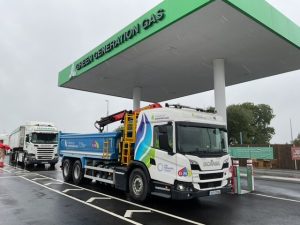
Gas Networks Ireland hosted the opening of a new BioCNG (Bio Compressed Natural Gas) refuelling station at Junction 14 on the M7 motorway in County Kildare. This marks a major milestone in Ireland’s journey toward decarbonising its commercial transport sector, which is responsible for up to 20 per cent of the country’s transport emissions.
Demand for gas in transport continues to increase
This development responds to the increasing demand for gas in Ireland’s transport sector, with renewable gas usage in transport consistently rising over the past few years. From January 2023 to August 2024, gas consumption in transport has seen significant month-on-month (MoM) and year-on-year (YoY) growth, demonstrating a shift towards cleaner fuel alternatives as Ireland moves to decarbonise its commercial transport sector. This upward trend has continued into 2024, with YoY renewable gas usage increases reaching 65 per cent in July and 80 per cent in August.
In 2023, gas demand from Ireland’s transport sector recorded consistent MoM increases, peaking with a 16 per cent increase in March. Year-on-year, the numbers reveal even more substantial growth: February 2024 saw an 11 per cent rise over the previous year, while April’s usage was up by a staggering 42 per cent. The development of the CNG network via the Causeway Project is supported by a grant from the EU’s Connecting Europe Facility Transport Fund and the Gas Innovation Fund, approved by the Commission for Regulation of Utilities (CRU).
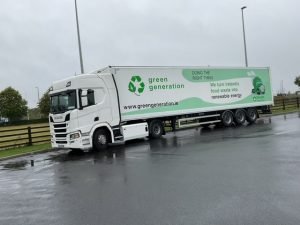
Locally produced biomethane
Delivered by Gas Networks Ireland and Lidon Group, supported by the Causeway Project1 this station is set to transform one of Ireland’s busiest transport corridors into a cleaner and more sustainable route for heavy goods vehicles (HGVs). It is the sixth public CNG station to be completed and the tenth operational station in total (four private stations also complete).
This new BioCNG station will supply biomethane produced locally in Kildare by Green Generation, using local food and farm waste, supporting Ireland’s circular economy by converting waste into renewable energy. BioCNG offers a cleaner alternative to diesel, reducing harmful emissions from HGVs and helping Ireland meet its ambitious climate action targets.
BioCNG cuts a HGV’s carbon emissions by up to 90 per cent2, reduces lifetime vehicle costs compared to diesel and helps Irish hauliers to reduce their scope 3 emissions.
UNSDG (United Nations Sustainable Development Goals) Week
The launch coincides with United Nations (UN)Sustainable Development Goals (SDG) Week, highlighting Gas Networks Ireland’s commitment, as a UN SDG Champion, to leading by example in sustainable energy innovation. The opening of this BioCNG station strengthens Ireland’s green transport network, adding to the growing number of CNG and BioCNG stations across the country, including those in Dublin, Cavan, Limerick, Clare and Tipperary.
The completion of this station and increasing the availability for biomethane as an alternative fuel to diesel, is part of Gas Networks Ireland’s pathway to a net zero carbon network by 2045. This pathway outlines the commercial semi-state’s strategy to support the government’s target of integrating 5.7 TWh of biomethane into the gas network by 2030.
By 2045, it is projected that biomethane will make up c.30 per cent of the gas transported on Ireland’s network, with the remaining c.70 per cent to comprise green hydrogen. According to Gas Networks Ireland, by this date, natural gas will be fully phased out from the country’s gas network, marking a significant shift towards renewable energy sources.
Gas Networks Ireland’s Director of Customer and Business Development, David Kelly said:“Ireland’s commercial transport fleet makes up just three per cent of vehicles on the road nationwide yet is responsible for approximately 20 per cent of transport’s carbon emissions. BioCNG is key to driving sustainable supply chains and is a significant step towards net zero commercial transport in Ireland.
“We are committed to enabling sustainable energy services and are working towards transporting renewable gases at scale. We have partnered with some of the most prominent forecourt operators and haulage companies throughout Ireland to make the alternative fuel option of low carbon gas a reality for Irish transport. We are delighted to see the country’s tenth CNG refuelling station in operation. With the stations strategically located in Cavan, Dublin, Limerick, and Tipperary – and now Kildare we are enabling new cleaner transport corridors for Irish freight operators.”
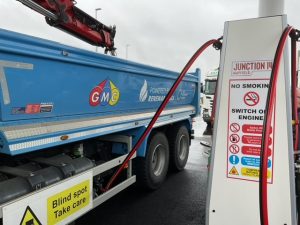
Liam Fitzpatrick, Director of the Lidon Group, which manages Junction 14, said: “We are delighted that Junction 14 is the first BioCNG station in Kildare, providing renewable biogas that has been produced through the recycling of agricultural and food waste here in our home county. Having opened this Motorway Services facility on the M7 13 years ago, we have seen the demand for renewable fuels growing steadily throughout that time. Today is a hugely significant day for us at Junction 14 with such a strong commitment being made to carbon reduction and sustainable travel for the future through this joint venture. The addition of biogas represents another step in that commitment to utilise and offer sustainable options on Ireland’s motorway transport network. Junction 14 was the first motorway public electrical charging point with 50kw and 11 kw units in 2011. In 2021 we installed an eight bay Super charger unit, which will be doubled in number in early 2025.
“As the demand for sustainable transport options grows, the opening of the BioCNG station at Junction 14 provides a vital infrastructure solution for the haulage and transport sectors. It will help to reduce the environmental impact of transport and contribute to Ireland’s overall goal of becoming a carbon neutral economy by 2050.”