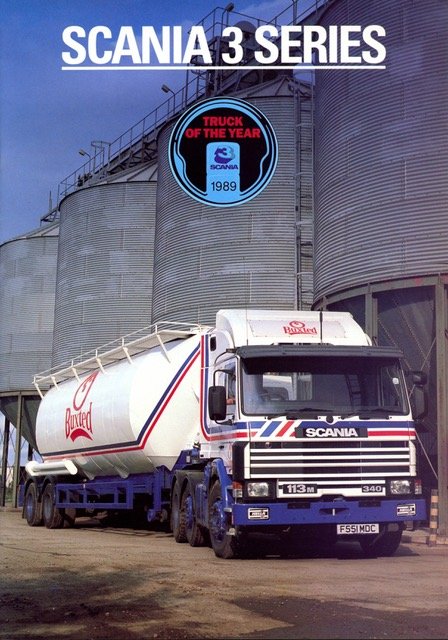
Having been a runner-up on no fewer than three occasions with various 2-series models, Scania prevailed in 1989, winning the coveted Truck of the Year award title (ITOY) with the 3-series.
The 1989 competition was regarded as somewhat of a two-horse race by the 13 European judges with the new Scanias and the Mercedes-Benz SK fighting it out for first place. The competing engineering philosophies – Scania’s evolutionary approach against Daimler-Benz’s more revolutionary design – eventually saw the Mercedes succumb to reservations about the unfamiliar technology at a time when few of the SKs had entered service.
The new Scanias were a model of evolutionary development with all the major component groups receiving some engineering refinement to produce a range of vehicles which were basically familiar to judges and operators but advanced to a new level of detail.
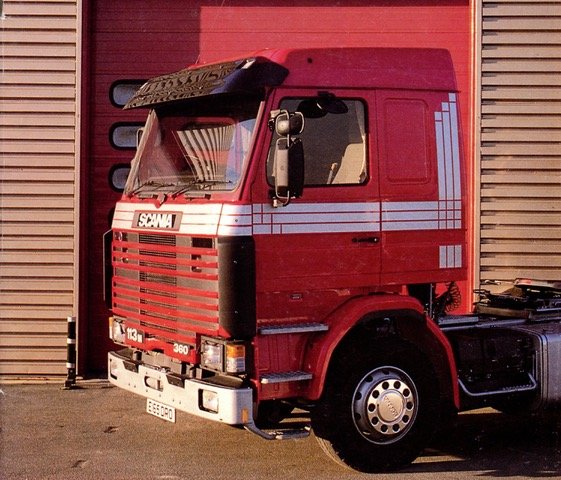
Following the designations of the 2-series, 3-series models retained the G, P, R cab designs across a range which started at 16 tonnes and ended with a 6×4 heavy haulage model of 150 tonnes.
The cabs themselves enjoyed a host of improvements including new seating and trim and an all-new wraparound dashboard designed by Open Design in Italy featuring revised switchgear and instrumentation. For long-distance operators, the new R cab received an optional 220mm higher roofline to become the “Topline”. The relatively modest increase was apparently chosen as a compromise between interior space and aerodynamics, and also permitted clearance beneath a fridge unit on a rigid chassis.
The Topline cab featured an aerodynamic sun visor with marker lights as standard and all of the cab range benefited from streamlined mirrors, improved dirt deflectors and electric windows on both sides of the cab. The R cab also became the only cab option for the highest-rated 11-litre model, which was the 360.
Power across the range came via eight engine options, with the 210hp, 230hp, 250hp and 280hp models using the 9.5-litre engines, and the 310hp, 320hp, 340hp and 360hp versions with the 11-litre. The V8 had one rating – 450hp – but Scania was offering the 470hp with Electronic Diesel Control to operators in Scandinavia before the Europe-wide roll out during 1989. All the engine ratings were quoted at ISO 1585 standards, with the nett installed horsepower typically rounded up to the next 10.
All of the engines received modified fuel injection equipment and an increased compression ratio of 16-to-1 for the 11- and 14-litre units, with the large V8 also receiving new piston crowns. The extra torque and power of the V8 led to the introduction of the new GR880 10-speed synchromesh gearbox operated by a pull-type clutch.
Work on the 3-series had begun in earnest five years before it entered full production in February, 1988, and was completed with more-responsive steering, lighter road springs and higher capacity front axles to make the new Scanias as good a truck as it was possible to buy in 1989.
Photo Credits: Richard Stanier & ITOY