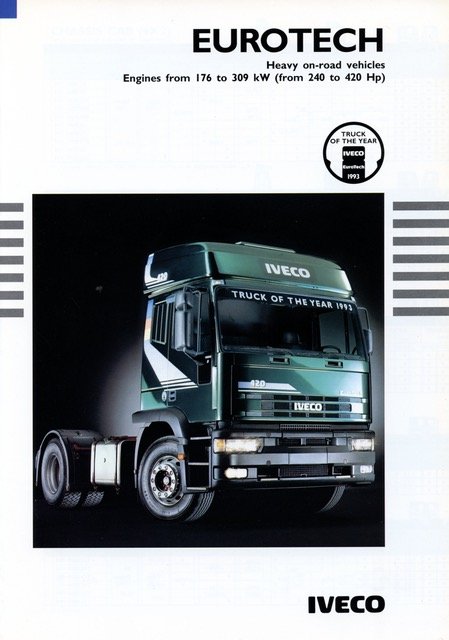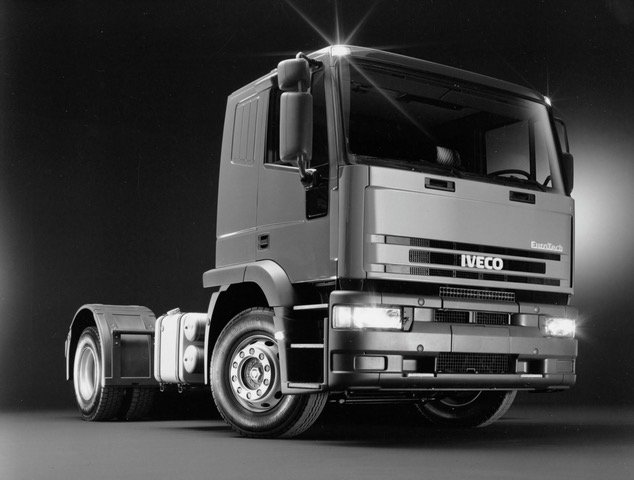
Iveco waited 15 years for its first International Truck of the Year (IToY) award and then two came along in a row with the EuroTech winning a close competition in 1993.
Having scored a convincing win in the 1992 competition with EuroCargo, the next phase of Iveco’s massive investment programme produced another winner with the EuroTech medium/heavy range. The new Ivecos saw strong competition from DAF’s 75/85 Series, with the 13 judges settling the question in the EuroTech’s favour by a mere four votes. The Volvo Euro-1 Geartronic came in a distant third.
The judges were intrigued with the differing approaches employed on the new Iveco and DAF ranges, with the new DAF models being a distinct model range between the 45 and 95 Series vehicles, and the Ivecos part of a highly-rationalised programme integrated with the EuroCargo and EuroStar.
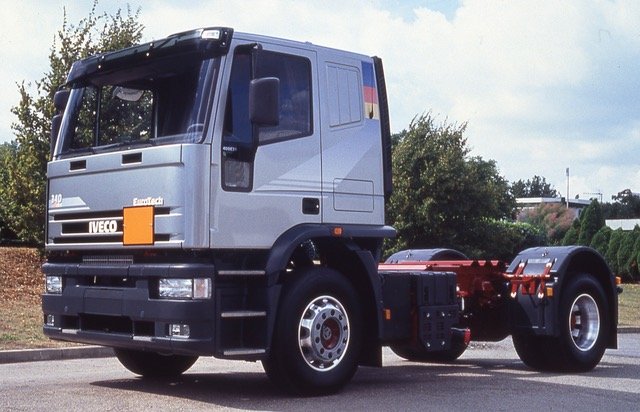
The EuroTech cab featured very similar styling to its smaller stable mate, but was 2.28m wide with four options – day, standard sleeper, top-sleeper or medium-roof sleeper (the latter selling itself a little short given its 2.02m internal height).
Engines spanned the 7.7-, 9.5- and 13.9-litre capacities, with the 9.5-litre available at 345hp or 375hp at its launch. The 13.9-litre was initially rated at 420hp, but a 470hp version was later added, along with a 300hp version of the 9.5-litre.
The new engines were developments of the existing 8000 Series with new piston designs, higher pressure, six-hole injectors and waste-gate valves which were all Euro-1 compliant at their launch. The 375hp 9.5-litre engine was electronically-controlled and the adoption of this size of engine in the 360hp-plus class presented a significant weight saving over its predecessor, which was built upon with aluminium cases for the ZF gearboxes, and fabricated steel chassis bracketry used in place of heavier cast iron.
Eaton Twin Splitter gearboxes were offered alongside the ZF Ecosplit and Rockwell dive axles featured on most models, with the Iveco hub-reduction unit reserved for some six-wheelers. Rear axle ratios ranged from 2.93:1 up to 5.7:1 to allow a wide range of performance possibilities when matched to various wheel and tyre sizes, and all the Iveco-built front and non-driven axles employed Bendix air-disc braking.
In keeping with its name, EuroTech was a truly pan-European engineering project, with engines built in the French Bourbon-Lancy plant, frame rails and cross members sourced from Turin, and cab panels pressed in Brescia. Final assembly was completed in the former-Magirus plant in Ulm for the Central and Northern European markets, whilst the newly-acquired Pegaso plant at Barajas, near Madrid, supplied France and Southern Europe.
The EuroTech was a strong contender and caused its rivals much concern but build quality on early models dogged the truck’s reputation to a degree.
Words: Credits: Richard Stanier & IToY