

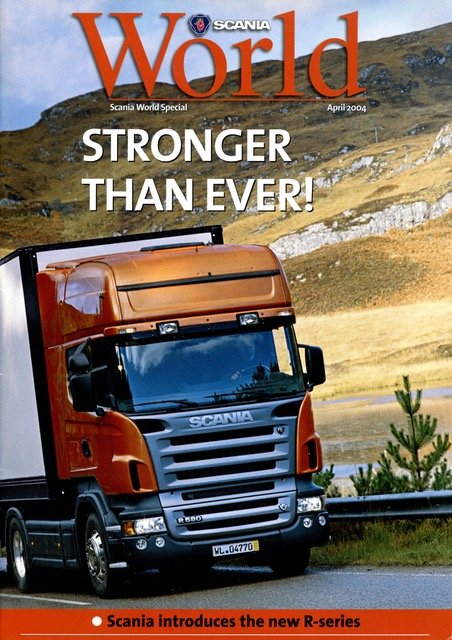
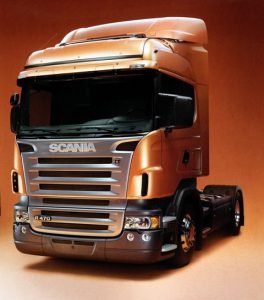
A new high-roof sleeper became available with the re-styled cab
In April 2004, Scania announced the new R-series model and immediately became a favourite to win the International Truck of the Year (IToY) contest for 2005, and as history records, that year was strangely quiet for new truck launches.
The R-series eventually went head-to-head with the MAN TGA with its new D20 common-rail engine, and the Renault Mascott. Light trucks are generally outside chances for IToY, and the new engine alone was not enough to clinch the competition for MAN, so the new Scanias scored a third win for Södertäljewith the judges expressing admiration of the improved driver environment and driveline.
In keeping with the Scania ethos, the R-series was an evolutionary product within a modular design concept which saw low-cabbed P models and the bonneted T-series launched over the following 12 months. The outgoing 4-series had received some criticism and the new Scanias were claimed to have had 35% of their content changed. The models also received a new naming convention with designations being by cab type followed by power rating.
The R-series cab received an extensive make-over with an all-new interior and the re-modelled dash was mounted closer to the windscreen to afford greater interior space. The cab was also slightly higher mounted to reduce the footwell depth to a mere 145mm, and provide for an “almost-flat” floor. New fabrics were introduced with light sand-coloured materials in the upper cab to enhance light and space, and darker, dirt-resistant materials in the lower areas.
The Opticruise and retarder controls became column-mounted, and the radio controls were incorporated into the steering wheel. The 4-series’ novel front bunk arrangement in the Topline cab was abandoned in favour of the conventional position to the rear of the cab, and a new high-roof cab design was added to sit between the standard height roof and the huge Topline. The new high roof cab – designated the CR19H – provided an additional 20cm of headroom and additional storage facilities above the windscreen.
Externally, the re-designed grille provided for a stylish facelift with the contoured lines enhancing the visual appeal of the cab. “The focus is no longer on the bars, instead the space between them is what creates the truck’s identity,” Scania’s PR people added, cryptically.
The R-series chassis benefited from a CAN-bus system integrated with new generation Bremse ABS and EBS disc brakes and an electronically-controlled air compressor. An Electronic Stability System was also offered on 4×2 tractors with air suspension and EBS.
The chassis itself was available with four-spring rear air suspension, and an alternative 7mm side member was offered for weight conscious operators. When supplied with a lightweight fifth wheel, 270kg of weight could be saved.
Scania’s renowned V8 16-litre was offered at 580hp, with the former 480hp uprated to 500hp. The 11-litre was offered at either 340hp or 380hp and the 12-litre line-up offered 420hp or 470hp. Scania also offered it’s first Euro-4 engine, being a 12-litre 420hp with turbo-compounding and EGR.
Words & Pics supplied by Richard Stanier Credit IToY
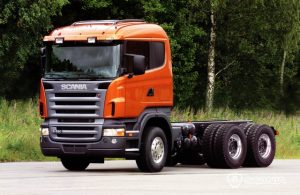
The 420hp engine with EGR became Scania’s first Euro-4 engine
The R-series was announced in April 2004